

How To Disassemble And Clean A Darkfield Wireless Mouse
But the other solar day my trusty Logitech Performance MX wireless mouse began a nasty habit. This nasty addiction began as an annoyance ane day and then had snowballed to all out rage ii days later. What was the trouble? Single left clicks had go double clicks. Later on 6 years of service, the left click button had finally failed and was getting stuck.
Not wanting to replace an otherwise perfectly skilful wireless mouse this was a practiced opportunity to teardown and hopefully repair.
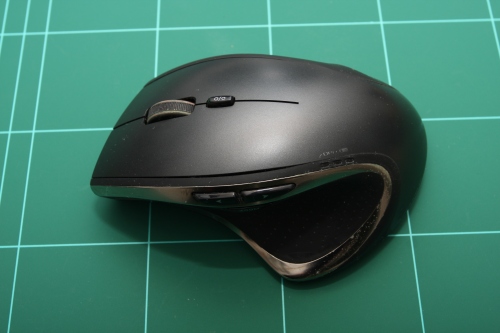
Getting into the mouse requires removing the nylon anxiety on the mouse's underside. Backside the nylon anxiety are four small-scale philips head screws.Have extra intendance when removing the anxiety to avoid peeling the nylon from the sticky backing. You want to ensure the pasty backing remains clean so put in a prophylactic place upside down.

The two halves of the case easily separate with only 1 internal plastic prune situated under the thumb rest.

To my surprise there was more than hardware internal to the mouse than I was expecting.
The mouse button limit switches looked surprisingly like in size and shape to other computer mice that I'd pulled autonomously. Perhaps there is some defacto standard?
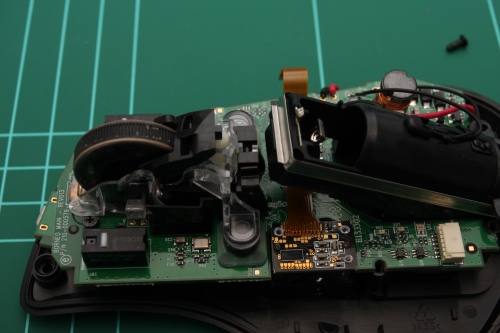
The limit switches are fabricated by OMRON and have a office number of D2FC-F-7N.
Removing the main circuit board from the mouse is tricky. The primary trick is removing the curl bicycle assembly – simply there are no screws. To remove the coil wheel assembly, there is a locking pin that has to be removed which is rather unique.

Black locking pin installed in the heart of the picture.

Locking pin removed

Scroll wheel assembly lifts out
Once the scroll wheel assembly is out, remove the 8 small philips head screws and the flat flex ribbon cablevision. Slide the tab on the flat flex connector upward to remove the ribbon.

Remove 3 screws from the battery holder and 1 screw to the left of the bombardment holder.

Remove the 2 screws from the front of the mouse

2 screws are hidden within the scroll bike mounting bracket.
Do not lose the 2 small springs that are at the front of the mouse.

Once all the screws, springs and flat flex ribbon cablevision are removed, jerk the excursion board out.

Inspection of the underside reveals that at that place is an Atmega324PA microcontroller running the mouse. For bluetooth wireless communications, there is a Nordic NRF24L01 chip with trace antenna. This chip was quite pop a few years ago, even Sparkfun fabricated a breakout board for the chip. Lots of testpoints and three pin ICs, probably transistors. The switch abreast the Atmega324 is the power switch.

On the topside of the lath there are 2 large ICs, many smaller ICs, a skillful sprinkle of discretes and a rather large inductor. Within the battery housing is a thermistor which would forestall battery over-temperature.
The largest IC labeled HA574 is an Octal Edge-Triggered D-Type Flip-Flops. I doubtable this is used to count the pulses from the whorl wheel'south photo transistor. The smaller IC has a generic number but would be a Ni-MH battery charger chip that works with the large inductor to recharge the internal battery.
To repair the faulty switch an onetime serial port mouse was sacrificed. Pitiful to any Commodore fans out in that location if this sacrifice is a tragedy. I did do a quick check on eBay and the mouse didn't seem to exist collectible.

Inside, was a single chip solution, three switches and a good old mouse ball. Who misses cleaning the lint from their mouse? As I suspected the mouse button switches in the MX looked virtually the same size and one was removed with some solder wick. Some quick concluding checks with a multimeter confirmed that the switching polarity of the ii switches matched.

Removing the faulty left click push from the MX was more troublesome. Solder wick wouldn't completely blot the solder. A solder sucker was no employ either. Finally I had to resort to using a small flat blade screwdriver to slowly prise the onetime switch out whilst heating the solder. This process must be done slowly because it is like shooting fish in a barrel to overheat a PCB and tear traces or even worse, pull the via out. One time removed, supplant with the new switch and solder in place.

Slowly prise the old switch out whilst heating the solder

Erstwhile switch removed

New switch installed ready to be soldered

Replacement switch installed and internals re-assembled.
Take your time re-assembling the mouse, basically follow the dis-assembly steps in reverse. However, hither are a few things to retrieve:
- two springs for the scroll wheel
- scroll bike assembly is secured with the locking pin
- reconnect the apartment flex ribbon cable
- go on the battery removal tag clear when installing the bombardment housing screws
- Make sure the power switch mechanism on the bottom half of mouse trunk and switch on the bottom of the PCB mate correctly
- 8 screws need to be installed to secure the PCB and battery housing
- small plug for the top half of the mouse trunk needs to be plugged in to the PCB
- iv screws hold the two halves of the body together
- slowly supplant the nylon anxiety and give them a practiced printing dorsum into position
Overall, the MX works perfectly once again with its donated switch. The clicking action with the new switch feels different and a bit clunky, but that is due to the differences in switches. Its possible to buy replacement D2FC-F-7N switches on eBay and have them delivered for a couple of dollars. Just, if you lot are in a pinch, y'all may exist able to reuse the switches from an obsolete mouse.

Source: https://steelcityelectronics.com/electronics/logitech-performance-mx-teardown-repair/
Posted by: williamsblospas73.blogspot.com
0 Response to "How To Disassemble And Clean A Darkfield Wireless Mouse"
Post a Comment